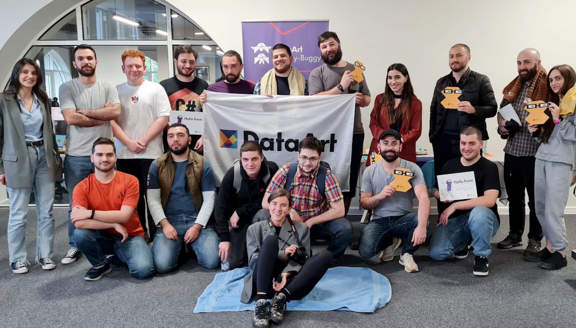
We’ve asked Ukrainian competitive programming coaches how to best manage one’s time at the contest, how to choose a programming language for solving the questions, and how to prepare for Proggy-Buggy. The tips they gave are useful to both beginners and experienced contestants.
Alfiya Antonova, coordinator of the school division of AUCPC (All-Ukrainian Collegiate Programming Contest), Associate Professor of the Department of Information Technology and Cybersecurity at Odessa National Technological University, coach, and organizer of programming contests:
We’ve developed a plan to prepare for programming contests, as well as an algorithm to follow at the competition, based on our own experience gained at various levels:
- Go and study problems from the previous year and watch analyses of how they were solved in advance on YouTube.
- At the very beginning of the contest, look through all the problems and choose the easiest ones to do first.
- Don’t submit any problem with an UNDECIDABLE status unless you are an experienced participant of the Proggy-Buggy Contest and can prove that there’s no solution in at least two ways. Signs of a problem being unsolvable are the absence of a sample, or constraints that don’t match the sample.
- For experienced participants: try to solve 2 problems in the first 5 minutes, then open the standings every 10 minutes to see what others are solving, and go in their same order. The goal is to win with 8-10 problems done!
- For beginners: try to solve 4 problems. After 15 minutes, open the standings and see which problems most of the participants have solved – most likely these are the simplest ones.
Oleksandr Vechur, Associate Professor of the Department of Software Engineering at Kharkiv National University of Radio Electronics, PhD, coach, and organizer of programming contests:
First of all, I think it's very important to hold such competitions in this difficult time for our country. It's not easy, but the value of such events for students cannot be overestimated. Contests and competitions may be intimidating for beginners, and they may seem very difficult, but Proggy-Buggy is one of the most exciting contests I’ve seen. A huge advantage is that it's done in an easy, fun, and accessible form: the solutions to the problems are short, and there are many tasks that test logic and ingenuity.
Before entering any competitions, even the fun ones, you need to first study the rules carefully, browse through the problems of past years, try to solve them, and compare your solutions with video analysis. You always need to be careful when you state that the problem has no solution – it's better to double-check your answers before submitting them.
Proggy-Buggy is a fun and positive contest, so I advise you to enjoy it. This is not just another dull event – this is a fascinating show.
Alexander Groskopf, winner of Proggy-Buggy 2021 in the Amateur category:
You don’t have much time to pull yourself together in only 42 minutes, so you need to work very dynamically. Don't get hung up on one task. If you can't think of a solution for a long time, look at the other questions. It's important to distribute problems among team members, so that two people don’t work on the same one. The problems are mostly not very difficult, with many solutions based rather on logic. Therefore, you need to find some interesting idea for a solution. But I emphasize that the main difficulty arises from the small amount of time given. You need to pay attention to it.
Oleksandr Khyzha, Associate Professor of the Department of Computer Technologies of Oles Honchar Dnipro National University, PhD, coach, organizer of programming contests, and member of the Proggy-Buggy Organizing Committee:
When it comes to programming languages that are better to use, C++ is the most common choice for competitive programming because it's a modern take on very performant code. But the language you choose is not very important for our contest. You simply need to choose one you are comfortable with: C, C++, Pascal, Java, Mono C#, Python, Ruby, PHP or JavaScript.
You can practice at the Proggy-Buggy Contest website. I would also suggest eolymp, which is just as incredible as Ukrainian borscht. And, of course, you should pay attention to one of the oldest contest websites – that of the Spanish University of Valladolid.
There’s still some time left. Get ready and keep in touch. We hope you'll find these tips helpful.
We look forward to seeing you at the Proggy-Buggy Contest 2023!