

Trying to derive a formula for feedback that works is like an unending search for the philosopher's stone. So says Elena Teneta, Head of Grievance management at DataArt, who has worked in HR management throughout her professional life and, as an experienced alchemist, has accumulated many examples of both the helpful and destructive effects of feedback on colleagues’ professional fate and work relationships. In her article, Elena shares 10 insights that will help make feedback meaningful and useful for all participants.
Our life, as well as personal and work relationships, are accompanied by constant signals of mutual feedback: ACTION → RESPONSE → ACTION CORRECTION. Feedback is something like an echo sounder that allows us to feel the boundaries of another person, assess the distance between us and receive confirmation that an interaction is taking place: “I am getting the signals, therefore I am.”
In general, of course, we know everything about ourselves. But this knowledge is heterogeneous, and some parts of it can only be accessible to us through others. This is well demonstrated by The Johari Window model: if we listen to some things about ourselves calmly, most likely we are talking about an open zone, i.e. things that we already know about ourselves. And when seemingly innocent reviews suddenly cause vehement denial, most likely our reviewers pointed to something from a hidden zone, exposing our shadow. Our reaction to feedback explains a lot about ourselves.
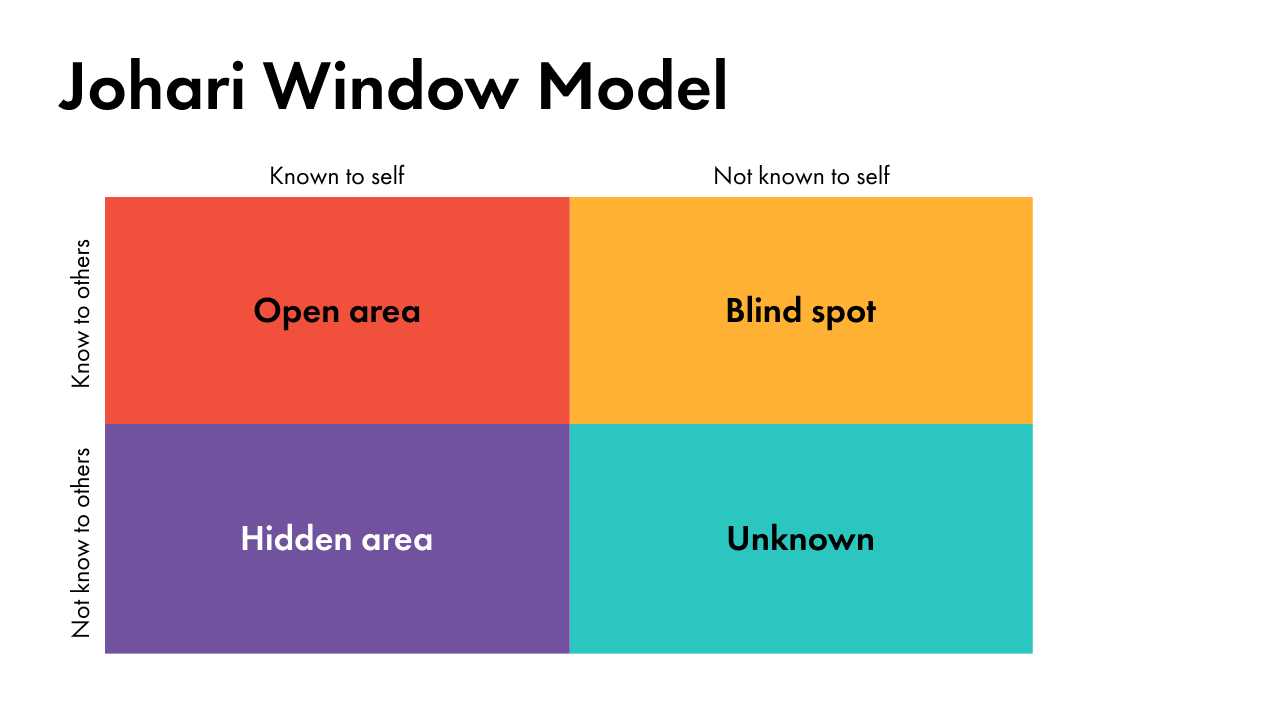
The main value of feedback is not only the opportunity to see your blind spots but also the ability to calibrate mutual expectations: between me and the team, me and the manager, me and society. It would seem that from all points of view, it is a useful and necessary thing, but for some reason, it does not always work as expected.
10 things that can go wrong
1. When we consider a colleague as an object, and not as a full participant — subject of the process
One of the signs of an object-based approach is collecting and discussing feedback behind your back. This causes discomfort and mistrust, even if the reviews themselves are entirely positive.
Recently, one of our colleagues left to work in a big tech company, and he said that there is feedback for every little thing, and this is an automated system: all “thank you” messages in chats are taken into account and can add up to a bonus. He really liked it, but the feedback on him, collected by the manager without the knowledge of the colleague, angered him and raised his first doubts about the correctness of the employer’s choice.
2. When feedback is implicit
Remarks over coffee or tea are perceived as maintaining small talk or friendly advice, rather than working feedback. Moreover, such informal feedback always gives a colleague a reason to pretend that nothing happened.
The most common motive when requesting a 360 review is: “I’ve never received full feedback,” and the manager’s most common reaction to this is amazement: “I talk to them every day in the kitchen over coffee!”
3. When we do not take into account cultural characteristics
In business, as in life, what in popular psychology is called the “love language” matters: it is very important to speak the language, in the register that our counterpart recognizes and accepts.
In addition to individual characteristics, the language of feedback is influenced by the existing culture: country, company, and market. Taking into account cross-cultural differences is critical for international companies like DataArt.
For example, Western Europeans will be more open to dialogue and the discussion of problematic issues. In Eastern European culture, it is more likely that during the early stages of a discussion, people may close down or remain silent. In the US it is important to be extremely literal, but in Japan it is worth abandoning direct formulations and using comparisons and projections.
4. When we want to correct something that cannot be corrected
Obviously, this also includes physical or mental characteristics.
Overall, the best strategy seems to be to build on your strengths rather than try to comprehensively develop spherical cows in a vacuum.
5. When we accidentally objectify
We often don’t notice how we weave gender differences, as well as differences in age and experience into the fabric of feedback. It is extremely important to move away from such “supporting” arguments: “This is not how real men act”, “Girls are always more careful”, “You have so much life experience, shouldn’t you know”, “Of course, you didn’t live in a time when..."
6. When we give feedback around others
It seems that everyone knows that negative feedback should be given one on one. Let me suggest that it is better to give any feedback personally. Why? Because public personal feedback is automatically a message for the entire audience, and an unexpectedly positive review for one colleague can become negative for others.
7. When we praise the wrong things
If we praise a child for trying, they learn to demonstrate diligence; If we praise correct actions, we reinforce these actions. It’s the same at work: it’s better to mark specific actions and results with positive feedback, rather than correct intentions.
8. When we impose feedback
You can refuse feedback. Yes, the company can do it too. Any choice is correct if we make it consciously and are ready to take responsibility for it.
Why might we refuse to receive feedback? We don't trust this person; they are not an authority for us; the manner of providing feedback contradicts its idea; we don’t feel safe or feedback demotivates us; finally, we just don't need to give this much feedback.
DataArt believes that receiving feedback is voluntary, but it is always useful to understand what is behind each specific rejection.
9. When we don’t use the services of specialists
Feedback can be delegated. In the corporate world, it is normal and expected that negativity will be dealt with by specially trained people and special tools. Systems for collecting anonymous group feedback, feedback sessions with the participation of HR or PM, Helpline, and Grievance exist, among other things, to help colleagues correctly convey negativity or reduce the likelihood of passing off personal hostility or prejudice as objective feedback.
10. When we confuse feedback with quality assessment.
Feedback is not always about evaluation or improvement, it is often about care i.e. making the person know that we see them. The very confirmation that we exist from the beginning of the article. Being ignored is one of the most intolerable things. At the same time, we are all concerned about our boundaries, so our managers have to strike a balance.
Feedforward
The most fair and correct feedback appeals to the past — even if we completely agree, for example, with a negative review, we still cannot change anything. A little life hack on how to turn that lemon into lemonade is called feedforward.
Feedforward is an advance adjustment of future actions, i.e. a real opportunity to change future behavior (and, possibly, receive positive feedback in the future).
- “You always send reports late” — this is feedback.
- “Accounting would be able to accrue on time if, starting next month, you sent reports every 25th day before 18:00” — this is feedforward (you can immediately discuss what needs to be done for this).
By the way, any complaints against the company can also be formulated as feedforward — this will be more constructive, more like an idea for improvement, and will demonstrate a willingness to invest in solving the problem.
DataArt's feedback principles:
It's not like DataArt invented the perpetual motion machine. But we found something (and judging by the fact that we have been living and developing successfully for 26 years, we found it correctly), observing and analyzing, and we intend to carefully develop it further:
- Proactivity. It means that if you would like to receive feedback from someone, you can just request it from them.
- Variability. Our company uses tools with varying degrees of urgency, depth, and formalization of feedback — from one-click express reviews to a full-scale Review System.
- Individual approach. Everyone determines the regularity and completeness of the feedback that they are personally comfortable with.
- We're always there for you. It means that at least once a year your local HR will approach you to see how you are doing, just to be on the same page.
- Environmental friendliness. We learn and teach how to give and receive feedback beneficially and ensure the proper level of confidentiality. In addition, for a safe and supportive dialogue in difficult situations, DataArt has a corporate Helpline for emotional and psychological support and has developed Grievance mechanisms.
- Taking into account intercultural characteristics. Our library of cross-cultural diversity courses, aimed at managers at all levels, is regularly expanded and updated.