
The Negotiation Cycle
Negotiation is a critical skill in project management, regardless of the methodology you follow. Essentially, it's a process of reaching an agreement through several stages—the negotiation cycle:
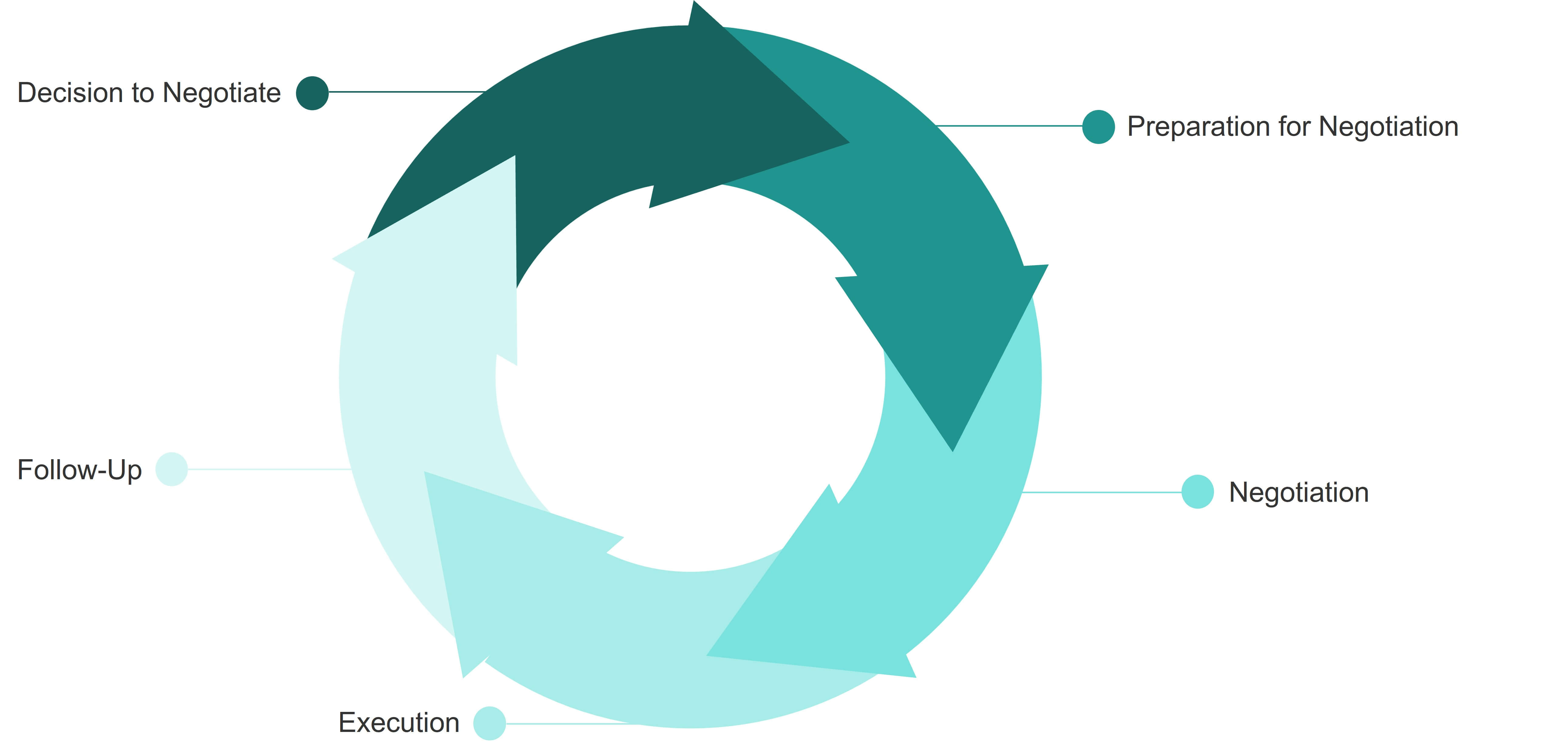
- Decision to Negotiate. Assess whether to engage in negotiation and choose from four strategies: dominating, accepting the other party's view, avoiding negotiation, or engaging in mutual negotiation.
- Preparation. Define your goals and potential compromises, and understand the same for your counterpart.
- Negotiation. Develop mutually beneficial ideas, consider alternatives, and select a way forward.
- Execution. After an agreement is reached, both parties must fulfill their promises.
- Follow-Up. Maintain relationships with counterparts after the negotiation ends.
It's important to note that these steps are not rigid and may overlap. For example, if a party fails to fulfill their commitments, it can lead to a conflict.
Conflict Causes and Signs
Conflicts can arise for various reasons. While not exhaustive, this list still covers the most essential:
- Disagreement over tasks
- Miscommunication or misunderstanding
- Differences in values or opinion
- Uncertainty or conflicting priorities
- Resistance to change
- Unrealistic expectations
- Toxic work environment
- Unresolved issues
The most common signs of a brewing conflict include:
- Unexpected changes in communication style, such as odd comments or avoidance behavior
- Body language signs like avoiding eye contact, crossed arms, frowning, or facing away
- A noticeable drop in productivity or work quality
- Increased complaints about work conditions, colleagues, or management
- Signs of anxiety, such as being on edge or avoiding social interactions
- Direct resistance to your decisions
- Reluctance to collaborate
- Defensiveness, such as deflecting blame and avoiding dealing with the issue
- A decline in trust among team members
Always keep in mind that people respond to conflict differently: some prefer to tackle problems directly, while others tend to avoid confrontation.
Conflict Assessment Tool
Ken Thomas and Ralph Kilmann’s Conflict Mode Instrument (TKI) helps assess conflict through two axes: assertiveness (the degree of concern for your own needs), and cooperativeness (the level of concern for others' needs).
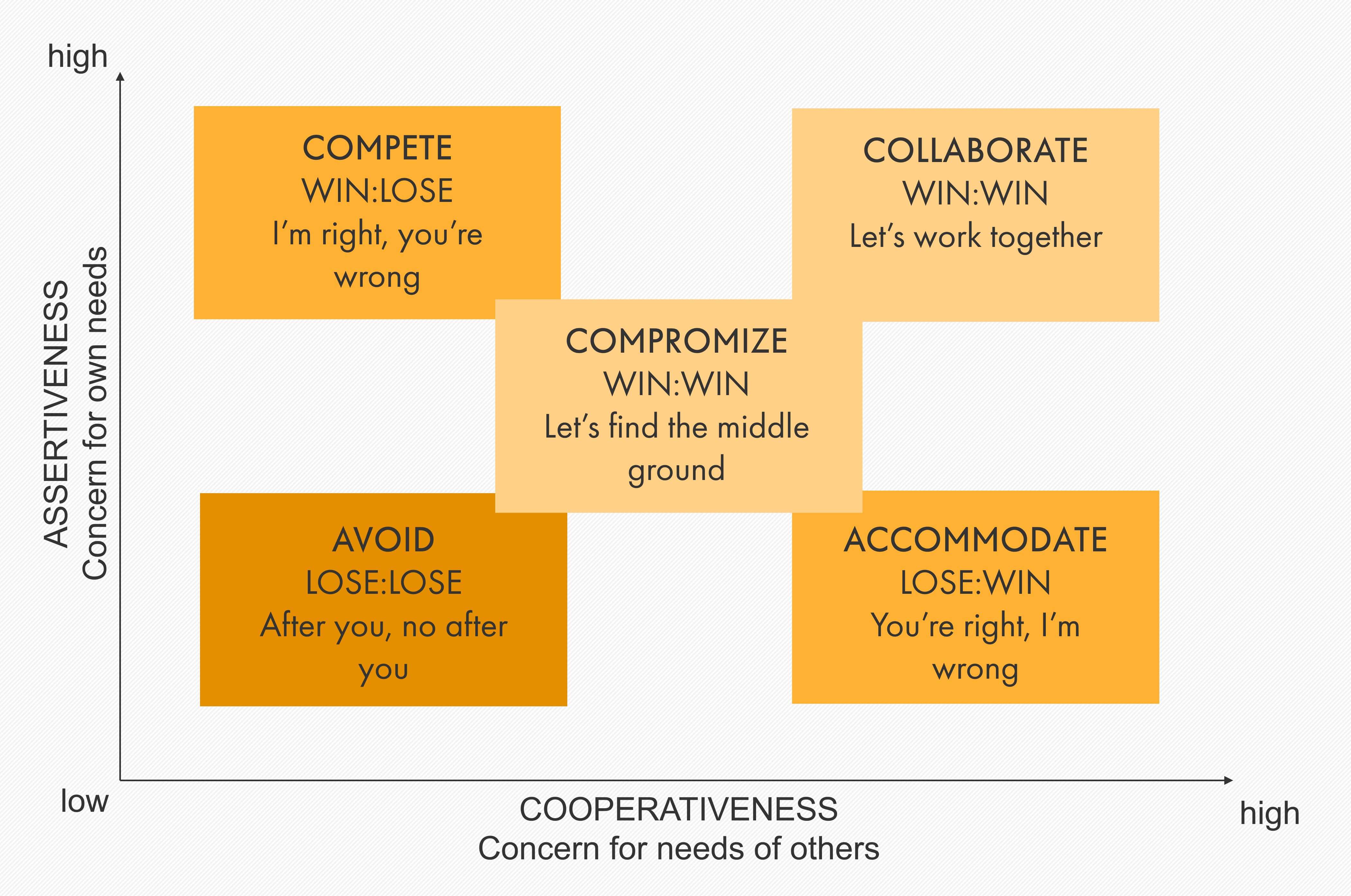
Within this framework, you can follow five strategies:
- Avoid: A passive approach where you sidestep the conflict, useful when the issue is trivial or when you need time to think and collect information before you act. Use this strategy when the situation is too heated and needs to cool down. However, avoid overuse to prevent unresolved issues from piling up. Ensure that avoidance is not perceived as neglect by communicating your intent to address the issue later.
- Compete: It involves standing up for your rights and defending a position you believe is correct. It’s effective in emergencies requiring quick, decisive action. Use when stakes are high, but be clear and assertive, not aggressive.
- Compromise: The objective is finding a mutually acceptable solution that partially satisfies both parties. It’s useful when goals are moderately important but not worth the effort or potential disruption of more assertive modes. Aim for fairness, giving up something of equal value. Use this strategy to reach temporary solutions under time constraints.
- Collaborate: A cooperative mode where you work with others to find a solution that fully satisfies everyone’s needs. Encourage open dialogue and information sharing. Foster an environment where team members can contribute ideas and solutions.
- Accommodate: This strategy involves putting the other person’s needs before yours. You might want to use it when you find you are wrong, to allow a better position to be heard, to learn, and to show you are reasonable. Use when preserving the relationship is more important than winning the argument. This approach is useful for building social credits for future discussions or negotiations.
This conflict model is simply a tool to help you organize ideas and come up with a resolution yourself. There are too many variables for any tool to be entirely foolproof.
Addressing a Conflict
Speed Leas' model is a notable approach to conflict management and resolution. It emphasizes the analysis of language used by conflicting parties to diagnose current states of conflict and select strategies for de-escalation. Speed Leas outlines five levels of conflict, each with unique language, behaviors, and recommended resolution strategies:
- Problem to Solve
The focus is on constructive arguments and finding the optimal solution. The conflict is relatively low in emotional charge.Manager’s Actions: Encourage team members to reach a consensus through collaboration, aiming for a win-win situation.
- Disagreement
The focus shifts to protecting personal interests, with accusatory and distant language and constructive arguments being reinterpreted and distorted.Manager’s Actions: Leave resolution to key members for decision-making, aligning with Agile principles and allowing teams to be self-managed.
- Contest
The conflict intensifies with personal attacks overgeneralizations, and the formation of sub-groups. The language becomes aggressive, and the objective shifts from problem-solving to seeking victory over the other party.Manager’s Actions: Foster compromise, negotiation, and continuous open discussion based on facts. Empower the team to resolve the conflict by themselves while providing monitoring and mitigation support if required.
- Crusade
There is an escalation between sub-groups, with ideological and aggressive language, each party striving to protect their own interests. Resolving the conflict is no longer considered a priority.Manager’s Actions: Act as mediators between the conflicting parties to de-escalate the conflict. Establish safe structures by following your company’s standards and setting rules regarding personal insults.
- World War
Highly charged environment with ceased communication.Manager’s Actions: Try separating conflicting individuals or groups to mitigate potential harm to the project.
Conflicts are a natural part of project management. Hopefully, you will never encounter the last two stages, Crusade and World War. However, understanding these stages helps in effectively managing conflicts in project management. We hope these techniques and strategies will empower you to become a natural at negotiation and conflict resolution.
Additional resources
For further exploration of negotiation and conflict resolution, check out these resources:
- Everything is Negotiable: How to Get the Best Deal Every Time by Gavin Kennedy | Goodreads
- Negotiation, Mediation and Conflict Resolution course on Coursera
- Conflict Management course on Coursera
- 5 Strategies for Conflict Resolution in the Workplace (hbs.edu)
- Conflict Management resources on MindTools
- From Challenges to Solutions: Problem-Solving Techniques (dataart.team)
- How Does DataArt Resolve Conflicts? Spoiler: not Like Other Companies