





It means project managers focus on delivering business value, not just executing tasks. Strategic PMs align projects with organizational goals, influence decisions, and support leadership priorities beyond schedules and budgets.
You are opening our English language website. You can keep reading or switch to other languages.

18.05.202612 min read
PMs as Strategic Partners: 3 Skill Gaps the Research Says Every PM Needs to Close
Kateryna Chornoknyzhna, our PM, explains why project managers need to move beyond task execution and act as strategic partners. The article breaks down the key findings from the Project Management Institute’s research, highlights three major professional gaps, and outlines the skills needed to close them, along with a practical plan you can start using right away.
Senior AI Solutions Architect with LLM and RAG, Knowledge Graph Platform
Almaty, Astana, Belgrade, Cluj-Napoca, Dnipro, Kharkiv, Krakow, Kyiv, Larnaca, Lodz, Lublin, Lviv, Odesa, Remote.BG, Remote.GE, Remote.KZ, Remote.PL, Riga, Sofia, Tbilisi, Varna, Warsaw, Wroclaw, Yerevan
Senior Data Engineer with Google Cloud Spanner and Graph, Graph Platform
Almaty, Astana, Belgrade, Cluj-Napoca, Dnipro, Kharkiv, Krakow, Kyiv, Larnaca, Lodz, Lublin, Lviv, Odesa, Remote.BG, Remote.GE, Remote.KZ, Remote.PL, Riga, Sofia, Tbilisi, Varna, Warsaw, Wroclaw, Yerevan
About PMI
The Project Management Institute (PMI) is a global association for project management, founded in 1969, with members in more than 300 regions. PMI runs large, data‑driven research to understand what drives project success. Their latest study includes data from 900 project managers and senior leaders worldwide, plus over 40 expert interviews. You can download the full report here.
The Threat
Data shows that 80% of high-performing Project Management Offices use AI and cloud technologies. Only 30% of other PMOs do. That's not a gap, it's a chasm.
As Adam Teakle from Cognizant puts it:
"If you don't have a GenAI strategy right at the very top of what you do, your business will fail."
This threat also comes with an opportunity. Organizations with high-performing PMOs grow three times faster than their competitors. The key difference: these PMOs act as strategic partners, not just task managers.
We have a choice: become strategic partners or risk becoming obsolete. Core PM tasks like tracking, reporting, administration, and scheduling are being automated. That makes human skills more valuable than ever. AI cannot build relationships, understand organizational dynamics, lead strategic conversations with executives, or resolve stakeholder conflict. PMs can.
Why Leaders and PMOs Aren't on the Same Page
PMI surveyed 1,905 leaders worldwide using MaxDiff analysis, which asks respondents to choose the most and least important options from a set. The largest gap they found was in strategic alignment. Senior leaders say 78% of PMO resources should be devoted to aligning projects with strategic goals. PMOs currently allocate 68%. That 10-point gap is the largest in the study.
Leaders expect PMOs to be strategic partners. Most PMOs still focus their time elsewhere.
Previously, being relevant meant delivering projects on time, within budget, and to a high standard. Now, relevance means making a strategic impact. Operational excellence is the floor, not the differentiator.
Many PMs still focus on frameworks, processes, and methods. Success is measured by hitting milestones and staying on budget. These matters, but leaders now value other things more.
This gap will not close on its own. Without change, PMs risk losing relevance, trust, and their seat at the table.
The Three Gaps
The data points to three main gaps. Let's look at each one and the actions we can take.
Gap 1: Customer-Centric Approach
The first gap is about who we serve and how we serve them. There is an 8-point gap in customer relationship management. Senior leaders expect 63% of resources here. We’re currently at 55%.
Why the gap?
Research shows that 41% of PMOs support four or more different customer groups: C-suite leadership, PMs, functional managers and teams, program managers, and external clients. Each group has different needs and definitions of success. A one‑size‑fits‑all approach does not work.
Yet most PMOs still use the same status report formats, meeting structure, and communication cadence for everyone.
A Customer‑Centric Model in Practice
Keri Anderson, Digital Global PMO Manager at SLB, supports more than 300 global energy projects. Here's how she applies a customer‑centric approach:
- Clarity: She is clear about who her customers and project teams are and focuses on enabling their success.
- Support: She provides proactive governance, not reactive oversight. Regular quality assurance reviews help surface risks early. She also reviews future proposals to ensure lessons learned from past projects are built in from the start.
- Alignment: Her work connects directly to corporate priorities such as cost leadership and strategic growth. The PMO stays focused on what the business values.
- Enabling Decisions: She validates project financials quarterly so managers can trust their data. The goal is better decisions, not oversight for its own sake.
The result: higher customer satisfaction, on-time delivery, and protected project margins. Customers reach out to her team rather than avoiding them.
Gap 2: Strategic Alignment & Value Realization
Strategic alignment shows the largest gap in the research: 10 points. Leaders expect 78% focus here; PMOs deliver 68%. For value realization, the gap is 6 points (65% expected vs. 59% current).
This reflects a pattern many PMs recognize: Delivering projects on time and within budget, meeting all requirements, but then learning six months later that the project added little or no business value.
The causes vary:
- No measurable business value defined upfront
- Solution not adopted by users
- Wrong problem solved
- Technically sound but strategically irrelevant outcomes
Delivering on time and within budget means nothing if the project does not support strategic goals. Yet most status reports still focus on task completion, schedules, and budget variances rather than on outcomes or business value.
The research identified two archetypes:
- Process-focused PMOs: They enforce standards uniformly across all projects. Issues are resolved as they arise, but the focus is on reports and metrics. Success is defined by process compliance.
- Service-oriented PMOs: Focus is on delivering value to customers. They adapt to project context, engage early, and offer services clearly tied to outcomes. Success is measured by efficiency, satisfaction, and value delivered.
Many of us still operate in a process-focused mode, even though we know the goal should be service-oriented. We hold on to what made us valuable before, instead of focusing on what will matter going forward.
A Practical Shift Toward Value
Arief Prasetyo, Integration HQ PMO Manager at SLB, manages over 300 global energy integration projects. His approach focuses on three principles:
- Governance and operational excellence are the baseline expectations, not differentiators.
- PMO work must be framed in the language of enterprise value.
- Metrics should show how projects affect company performance, not just project health.
He shifted reporting from purely project-centric measures to high-level indicators that connect delivery to business results. That requires close alignment with senior stakeholders and systems that support transparency.
The outcome: PMOs are viewed as a bridge between business insights and project execution, a strategic function rather than just a reporting layer.
Gap 3: Data & Technology Integration
We build AI solutions for clients. If we don’t use AI and data in our own work, we lose credibility.
The numbers are clear: 80% of high‑performing PMOs use AI and cloud technologies, only 30% of others do. If you're in that 30%, you're not slightly behind. Your capabilities are in a different league.
This is not about incremental process improvements. It is about changing how work gets done.
High-performing PMs use AI to:
- Collect, extract, and clean project data for analysis.
- Identify trends and patterns
- Support forecasting and planning
- Track key performance indicators
- Summarize project documentation and reports
All of these applications reduce administrative load, freeing PMs to focus on more strategic work. AI does not replace project managers; it lets us spend more time on tasks that need human judgment, creativity, relationships, and strategy.
In practice
Use AI for predictive insights. Instead of reporting what happened last week, use data analytics to anticipate what's likely next month. Identify risks before they materialize. Or flag resource constraints before they become crises.
For real-time decision making. As Nomathemba Dzinotyiwei, Head of Program Management at Absa Group, said:
"Use of real-time data is becoming more important than ever, especially when it comes to prioritizing and resourcing within the PMO and portfolio. Governance cannot be successful without data that we can depend on to make decisions."
Automate your administrative duties — status reports, meeting notes, action tracking, and basic metrics. Use that time to have strategic conversations.
One caution: technology without a is noise. Don’t adopt AI just because it’s trending. Use it because it solves real problems for your customers.
Three Skill Pillars for High-performing PMs
PMI identified three skills that high-performing PMs are developing. Consider them as the foundation for everything discussed above.
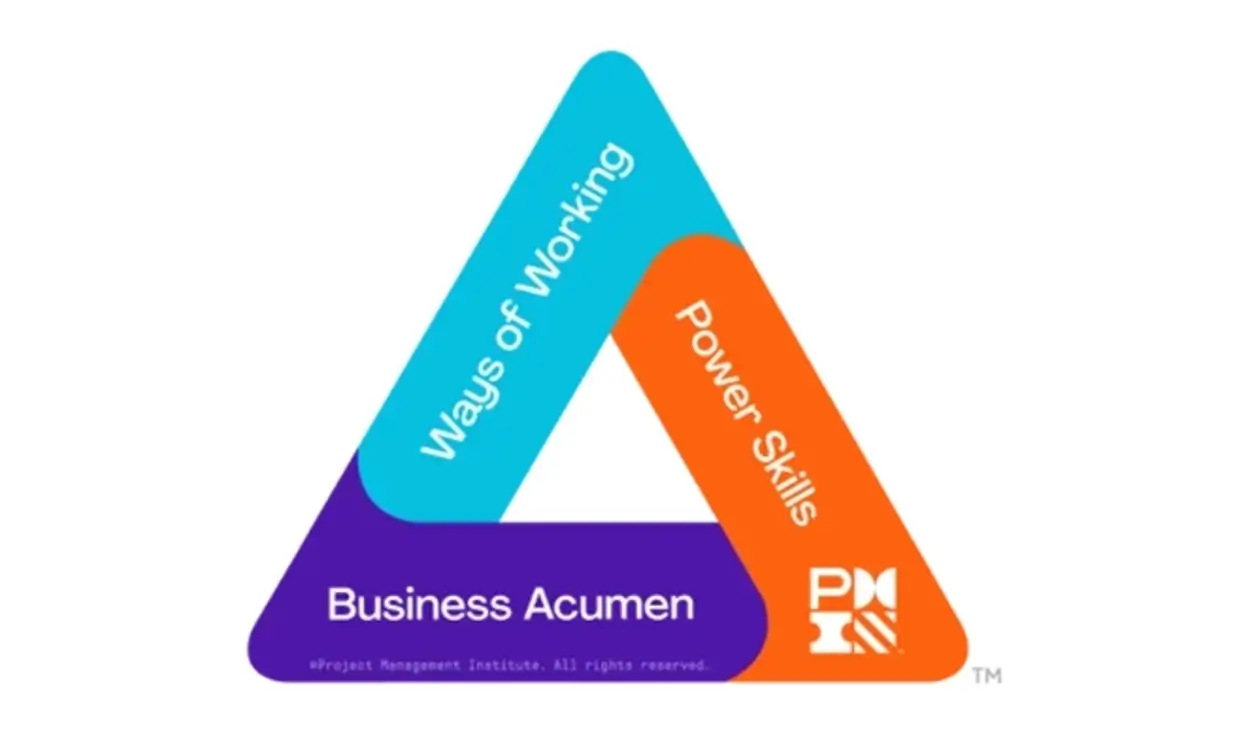
Power Skills
These skills are becoming increasingly important as AI handles more administrative work: communication, empathy, relationship-building, adaptability, continuous learning, and cross-functional problem-solving.
Hwee Ling Ong, Head of Business Operations at Illumina, captures why they are so important:
”You need project professionals who understand the different perspectives that exist in the organization. Your customers and stakeholders will all have different agendas. A key skill is being able to influence them, bring them together, and find a common path forward."
These are distinctly human skills: understanding subtle differences, managing workplace politics, building trust, and finding agreement. This is where your value lives, especially as more tasks are automated.
Business Acumen
It means understanding the business context, not just the project context. This includes organizational strategy, market trends, financial basics, industry knowledge, and how project outcomes connect to business goals.
If you do not understand how the company works, its goals, and what matters to leaders, it’s hard to be taken seriously. For example, you need to talk to your CFO about profit margins or to your CPO about customer retention. Use their language.
Ways of Working
In short: technical skills. Specifically, AI proficiency and data analytics. Learn to work with AI tools as project partners and build the data skills to deliver predictive insights and lead technology-driven change.
As Lucas Comerlato, Project Manager Coordinator at Marcopolo, says:
”While many trends are disrupting project management, AI is the most transformative. It's already transforming decision-making and accelerating project delivery. Professionals must upskill in AI to understand how and when to leverage it effectively."
The question is not whether to use AI, but how and when. That’s where skill development starts.
Mindset Shift: Progress over Process
The three skill pillars support the fundamental mindset shift:
| FROM | TO |
| I manage projects well | I drive business value through strategic execution |
| Process compliance | Outcome achievement |
| Measuring success by milestones hit | Measuring success by value delivered |
Schedules and budgets still matter, but they are the baseline. The real focus is on how your work helps the business achieve outcomes that count. This is what it means to be a strategic partner: human skills for relationships, business acumen to understand value, and technical skills to use data and AI for better decisions.
Start Here: Action Plan for Next Monday Morning
Here's a concrete plan you can start immediately.
1. Map Your Customer Portfolio
Block 30 minutes on your calendar and write down:
- Who are all your stakeholders? (C-suite, project team, functional leads, external clients)
- What does each group need from you?
- Where are the gaps? Where could you expand your influence?
Don't just think about it. Write it down.
2. Adopt a Service-Oriented Mindset
Before every meeting, report, or email, pause and ask: What outcome does the customer need? Do my actions help serve that outcome?
If you are doing it just because it's the process, or because it's always been done this way, that’s a signal to stop and find a better answer (or reconsider the activity!)
3. Align with the Organizational Strategy
Schedule a 30-minute coffee conversation with a senior leader and ask:
- What keeps you up at night?
- What are the top three strategic priorities for the business this quarter?
- How can our projects better support those priorities?
Just listen and learn. Then look at your projects through that lens.
If you feel bold, identify one activity that delivers no strategic value, stop doing it, and redirect that energy toward something that matters.
4. Implement AI Purposefully
Pick one of the top five AI application methods mentioned above. For example, using AI to summarize your meeting notes or automating the generation of your status reports. Run it for a month and measure the impact. If it works, scale it. If not, try something else.
5. Build Strategic Relationships
Schedule monthly touchpoints with senior stakeholders. Use that time to share insights, ask strategic questions, and understand their evolving priorities. Don’t just deliver status updates.
Lead with:
- “Here's what I'm seeing across projects that might be relevant to your priorities."
- “I wanted to get your perspective on how we should be thinking about X."
Position yourself as a strategic resource, not a project reporter.
6. Measure What Matters
Add one business outcome metric to your success criteria.
Work with the project sponsor to define:
- What business outcome are we trying to achieve?
- How will we measure it?
- When will we know if we succeeded?
Then track and report it with the same discipline you apply to scheduling and budgeting. Business value deserves a place on your project dashboard.
7. Gather Feedback
Send brief surveys to key stakeholders every quarter, with 3-4 questions:
- How can our project management practices better serve you?
- What should we START doing?
- What should we STOP doing?
- What should we CONTINUE doing?
Once you've gathered the feedback, implement changes and inform others what you did. This shows customer-centricity, builds trust, and ensures continuous adaptation.
The Bottom Line
You do not need to do all seven steps. Choose two or three that fit you and your situation and start there.
Small steps that change your practice beat ambitious plans that go nowhere.
PMs who will matter in the next decade are the ones who:
- Demonstrate clear business value
- Build strong strategic relationships
- Use technology to free up time for high-impact work
The research has shown the way. Now it’s up to you to act on it!
Subscribe to our IT Pro Digest
From AI and business analysis to programming tutorials and soft skills, we have it all!
You may also find this interesting
What does it mean for project managers to act as strategic partners?
Why is the traditional task-focused PM role becoming obsolete?
What are the main skill gaps preventing PMs from becoming strategic partners?
How does a customer-centric approach change project management?
Why is strategic alignment more important than delivering on time and on budget?
What is the difference between process-focused and service-oriented PMOs?
How should PMs measure success beyond traditional project metrics?
How can project managers use AI without losing credibility?
What are the most important human skills for strategic project managers?
What is the first practical step PMs can take toward becoming strategic partners?


